REAL ESTATE
Real estate investment requires looking beyond the pace of construction
Supply, absorption, prices, returns, vacancy and emerging development areas are the signals to assess the depth of real demand.
READ FULL ANALYSIS →A Radar Inversión vertical covering the market, projects, financing, demand, returns and real estate risk for business leaders, executives and investors.

Supply, absorption, prices, returns, vacancy and emerging development areas are the signals to assess the depth of real demand.
READ FULL ANALYSIS →Two Radar editorial products designed to move from reading the market to evaluating a specific investment.
Explore the editorial database by neighborhood, stage and asset type. Dated, verifiable information to understand what is being built in Asunción.
EXPLORE PROJECT RADAR →INVESTING IN PARAGUAYA practical roadmap before committing capital.
Inclusion in Project Radar documents publicly verifiable information. It does not constitute an investment recommendation or certification.
A quick read of the indicators that help size activity, financing and prices. Each figure shows its source and period; Radar's own data is published only when the methodology is verifiable.
Weighted average for the banking and finance system in local currency · July 2026. It is not specifically a mortgage rate.
The BCP reported a year-on-year decline in construction activity in July, associated with a slower pace of public and private works.
Cumulative approvals through June 2026; AFD reported them as a record high for the housing segment.
Market reference built from published asking prices. These are not deed values or actual closing prices. Radar will always show the methodology and data date.
We compare the main hubs and micro-markets to understand where supply is growing, where demand is emerging and how prices vary by area.
Explore the territorial distribution of projects identified by Radar and open the full interactive map.
How the developer equation changes when sales are referenced in dollars while a large share of costs is paid in guaraníes. Radar will track the exchange rate, price per m² and the impact on margins, pre-sales and sales velocity.
READ ANALYSIS →Spain is already among the European nationalities with the strongest residency presence in Paraguay. The Investor Pass adds a real-estate route from USD 200,000, while banking, compliance and information quality remain frictions for foreign capital.
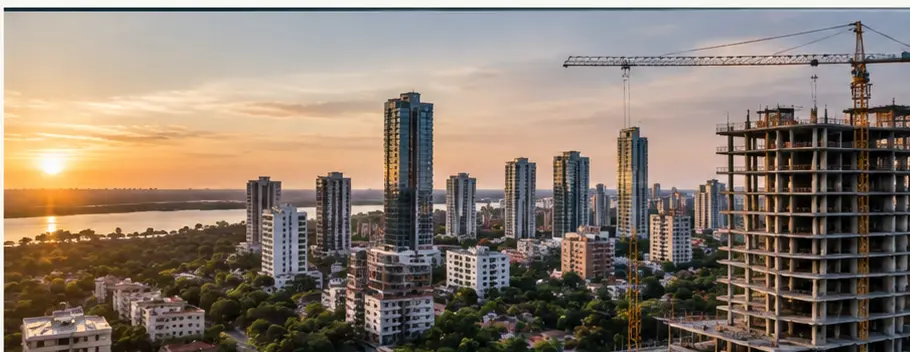
VIEW INTERNATIONAL INVESTOR →Asunción is entering a new stage of vertical development. The number of works confirms activity, but by itself does not demonstrate sufficient demand to absorb all future supply.
Published apartment asking prices are close to USD 1,800 per m² for the city, with significant differences between neighborhoods. Radar will track each micro-market separately: entry price, sustainable rent, new supply, inventory age and sales velocity.
Radar view: verticalization and construction activity are supply signals. The quality of an investment depends on how that supply relates to effective demand, rent, vacancy and price within each area.
Radar separates commercial data from editorial analysis: who participates, what it costs, what competing supply exists, what demand may absorb it and what risks may affect the outcome.
Each project will include location, typology, scale, units, stage, expected delivery date, developer, builder and asking price when available. The profile will show date and source to allow project comparison.
Radar will distinguish landowner, investor, developer, builder, sales agent and financier. Corporate or financial relationships will be published only when supported by public information or directly verifiable confirmation.
The editorial analysis will examine new supply, competition, price, accessibility, infrastructure, demand profile and absorption risk. The goal is to explain the project's impact on its micro-market, not to rate it as an investment recommendation.
Location, typology, scale, stage, expected delivery, developer, builder and published price when a verifiable source exists.
Competing supply, asking prices, infrastructure, observable demand and absorption signals, always with an identified period and methodology.
Each variable will distinguish developer data, public sources and Radar calculations. A commercial claim will not be presented as independent evidence.
Why currency changes the real estate equation
In Paraguay, asking prices expressed in dollars coexist with costs, wages, services and inputs that may be denominated in guaraníes. This makes the exchange rate a business variable, not merely a financial reference.
Radar will track the effect on three decisions: replacement cost, developer margin and the buyer's ability to sustain the investment ticket. Exchange-rate movements can change returns even if the published property price does not.
The goal is not to list companies: it is to connect player → capital → project → area → builder → sales agent to understand who is actually participating in Paraguay's real estate growth.
This block will not function as a commercial directory. Its purpose is to show the value chain behind each project and explain which companies develop, build, finance, invest and sell. Over time, Radar will be able to cross-reference players, projects, areas and track records.
We will track portfolios, completed and ongoing projects, areas, scale, prices, pipelines and alliances. CAPADEI will be a relevant source, but will not by itself represent the entire universe of developers.
We will identify who executes each project, the segments in which they participate, their geographic presence and their relationship with developers and investment groups. CAPACO and construction records will be part of the cross-check.
The map will seek to connect Paraguayan and foreign capital with holdings, funds, vehicles and publicly verifiable alliances, distinguishing investor, developer, builder and financier.
We will track who markets the supply, what inventory they represent, which buyers they reach and what signals they provide about local and international demand. Commercial claims will be separated from observed data.
The arrival of new residents, the Investor Pass and European interest add an international layer to the real estate market. Radar will track both opportunities and operational barriers.
Residency applications received by Migration authorities, 62% more than in the same period of 2025.
Residencies granted to Spanish citizens; Spain was the fourth nationality with the most residencies issued.
Minimum amount for real estate investment for economic purposes under the new regime.
Banks, AFD, mortgage credit, developer financing and policies that turn potential demand into effective demand.
Mortgage credit, rates, terms, installments, requirements and AFD programs. This layer helps measure how much potential demand can actually become purchases.
Equity, pre-sales, construction loans and other financing structures when public. Radar will examine how financial conditions affect construction pace and new project launches.
Credit will be read alongside permits, construction, supply and prices. An increase in financing does not by itself equal higher real estate demand: what matters is which segment it reaches and under what conditions.
A recurring conversation with someone able to explain a relevant market decision: a developer on capital and costs, a bank on credit, an investor on entry criteria, or a public authority on permits and infrastructure. The focus will be on figures, decisions and risks.